Showing posts with label Festivals. Show all posts

Tuesday, 1 September 2015

Frightfest London 2015: Awaiting Review

Dir: Mark Murphy
For some time now, horror fans have been awaiting that serial killer film that will take the genre somewhere new, somewhere beyond the era of torture porn. The punchline to this setup is, sadly, not “and here it is”. Awaiting would like to be a tricky, twisty, little beast, but the direction of the story feels obvious from the get go. The individual beats are just as predictable as they unfold, largely because they are mostly taken from other, better, films.

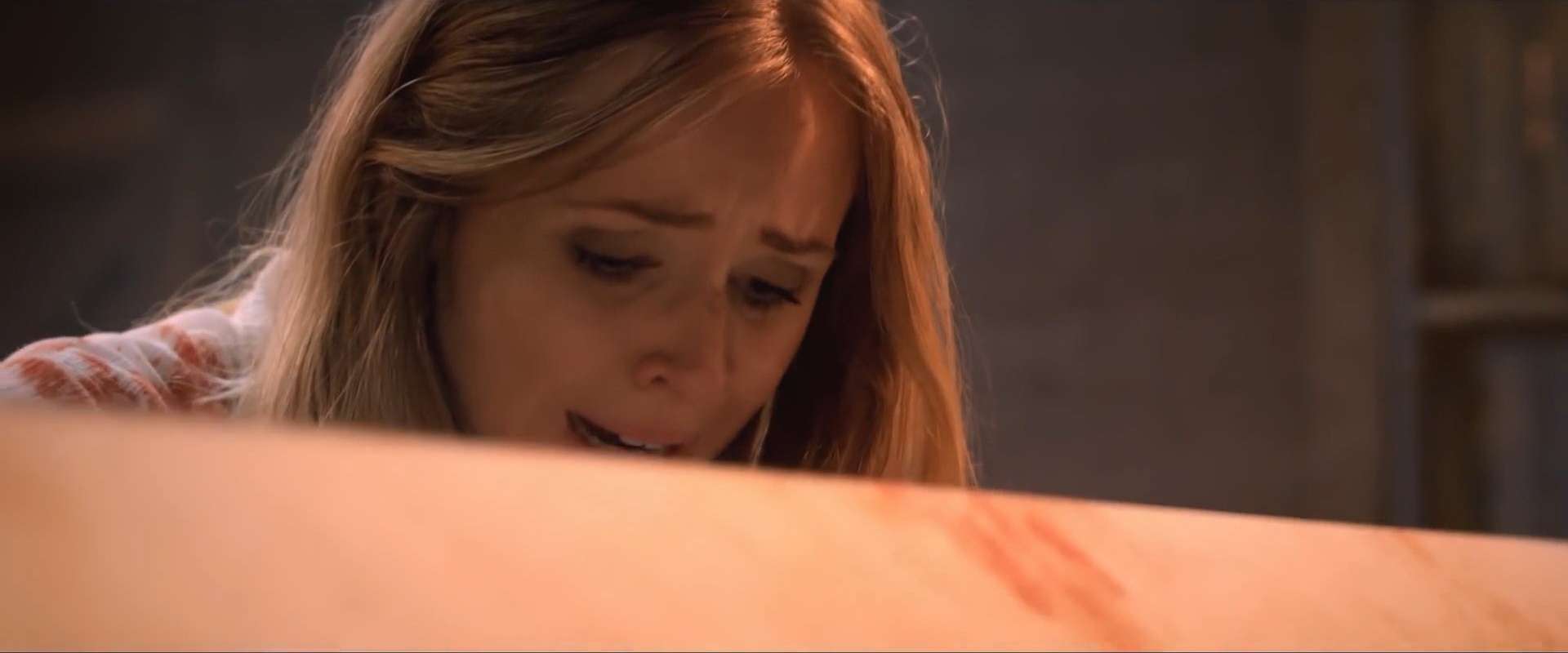
As the film opens, Morris (Tony Curran) returns home and tells his 20 year old daughter Lauren (Diana Vickers) that the unconscious passenger in the front seat of his car is someone he found in a crashed car. They take Jake (Rupert Hill) into the house and when he comes round, insist he stay the night. As time wears on it becomes clear that the relationship between father and daughter is unusual at best, that Morris is not well balanced, and that Jake isn't going to be allowed to leave.

Awaiting starts reasonably promisingly. The first act has a low key menace thanks to the queasily too close relationship between Morris and Lauren, and both Tony Curran and Diana Vickers (a former X Factor star in only her second feature) play that dynamic well. The way Morris has infantilised Lauren in order to control her is hardly a new idea, but it is effectively executed. An even more chilling version of this dynamic comes into play in a scene set at 'Christmas' (which Morris and Lauren celebrate in September). Lauren comes down in her late Mother's dress, dolled up, and acts the part of her deceased parent, even kissing her father. It's the film's best scene, hinting at a perversity that could be interestingly built on, especially given how good Curran and Vickers are in the moment. Sadly, Mark Murphy throws this moment away. It's frustrating, because done right (as in Josephine Decker's Thou Wast Mild and Lovely), this dynamic can be intensely creepy and provocative, here it's a loose end, an abandoned idea to facilitate the plot.

Even in the decent first act, problems are apparent. Rupert Hill isn't especially well served by a screenplay that gives him little in the way of personality and some rather clunky and cliché dialogue, but where Curran and Vickers sometimes overcome the same issues, Hill's monotone performance can't. This is a problem because he is, in many ways, the film's 'final girl' figure, and the fact he's so dull makes him hard to root for.

In the second and third acts, Awaiting becomes ever less distinctive, setting in motion the wheels of the plot-o-matic, allowing it to clunk through its default torture porn setting. Murphy plunders other movies like a magpie on a shoplifting spree. You'll recognise bits of Mum and Dad, Saw, We Are What We Are and just about every backwoods and torture porn slasher of the past few years. There's nothing inherently wrong with being generic, genre exists because it works, but if you are going to be generic after so many films have gone before you, then your take on the genre had better either have something to add or stand alongside the absolute best of its kind. Neither of these things are true of Awaiting.

I wrote the above paragraphs a day or so after viewing Awaiting, and I stand by them, but they merely scratch the surface of how depressingly unoriginal this film really is. About a week after seeing Awaiting I stumbled on a 1989 Canadian film called Cold Comfort. To say that Mark Murphy has drawn inspiration from the film (which he has told us he may have done, unconsciously, having seen it when he was younger) is, in my view, to dramatically understate the issue. For its first two acts the setting, the plot, the characters and their relationships to each other and even a clutch of scenes seem to be extremely closely influenced by equivalent moments in Cold Comfort.

If the problem were merely that one or two scenes echoed Cold Comfort then I would have added it to the list of films mentioned above and moved on. The problem seems to run much deeper. For example Awaiting's best scene, the queasy Christmas meal, is echoed almost beat for beat from Cold Comfort. In Awaiting the scene is set at an inappropriately timed Christmas, in Cold Comfort the celebration is of the 'Lauren' character's birthday, with the film introducing a lot of ambiguity about exactly how old she is. In both films the young woman comes downstairs dolled up, wearing clothes that belonged to her deceased mother, and puts on a sexual performance (a striptease in Cold Comfort as opposed to Awaiting's kiss) for the benefit of her Father and the man he has kidnapped and is holding hostage. The way the story proceeds immediately after this scene is also only minimally different in Awaiting.

This is just one of many examples in the opening twenty minutes alone of scenes that seem to astonishingly closely echo Cold Comfort. The extreme closeness of both the narrative beats and the images of the two films continues through the second act, before they drift further apart as Awaiting moves into a much more visceral third act. Even here though, there are still scenes that resemble each other very closely. This is problematic not only because it accentuates Awaiting's myriad flaws, but because it makes it very hard to credit Mark Murphy with its few successes, as most of them come in the portions of the film most closely echoing Cold Comfort.

Awaiting's third act brings it's own problems though. In its final half hour it becomes a series of scenes that you imagine must surely be the film's nadir, yet they aren't. In one especially cliché moment, Curran wrecks his serial killer lair in a fit of slow motion rage. This is such a hackneyed device that for it to be effective you must do something very different (look at Philiip Seymour Hoffman's slow, deliberate, destruction of all the stuff that surrounds him in Before the Devil Knows You're Dead), and simply shooting in slo mo doesn't really cut it. The character development, especially of Lauren, feels rather disjointed and there is one twist that, while a little bit surprising, is still ripped from yet several more better films. 

The film has two climactic sequences, both howlingly awful. First comes the exact ending you'd expect; a slow motion chase through the woods, complete with music that is desperate to convey some kind of epic gravitas on to the final conflict between our ineffectual hero and his ever less convincing antagonist. The clichés in the dialogue reach their ne-plus-ultra here, when Lauren actually says to Jake, in all seriousness, ”don't quit on me now”. My compliments to Diana Vickers for successfully keeping a straight face in that moment. Murphy manages to find an even less appropriate piece of music for what seems like the film's final coup de grace, then deliver a final confrontational beat so telegraphed and so hackneyed I was amazed that he didn't bother to in some way subvert it. And yet, the worst is still to come, in a coda that draws on The Texas Chainsaw Massacre and We Are What We Are (nope, not setting yourself up to fail there at all) and provides one character with another instant personality transplant. It is terrible, and loses the film a grade point all by itself.

Whether you see Awaiting or not – and frankly I can't suggest that you do – the one thing I would recommend that you do is seek out Cold Comfort, which is a considerably better and more original film, with outstanding performances from Margaret Langrick and Maury Chaykin. Ultimately the best thing about Awaiting is that it gives me a chance to recommend a much better film that you've probably never seen.

Sam's score:


Steve's second opinion:

My initial reaction to Awaiting was somewhat more enthusiastic than that of my Afraid of the Dark colleague Sam Inglis.  My tolerance for hackneyed plots is stronger than his and as a result I often find myself inclined to be a lot more forgiving than he is of horror movies, a genre that is , after all, replete with over familiar concepts.

I settled down to watch Mark Murphy's sophomore horror effort and, being a fan of Tony Curran, found myself caught up in this tale of backwoods madness.  Curran makes for a serviceable maniac and, surprisingly, I found myself more than a little impressed by the performance of ex-X-Factor contestant Diana Vickers.

I was settling on a score of 6 out of 10.  Awaiting was no masterpiece but it made for a mostly entertaining, moderately engaging slice of psycho cinema even taking into consideration the timeworn plot, the various script issues and a truly awful ending.  Like I said…I’m forgiving.

But forgiveness is not limitless and as soon as I saw Cold Comfort it would be a bit of an understatement to say that I was surprised by the extent to which the similarities between the two movies stack up. Awaiting mirrors huge parts of Vic Sarin’s 1989 chiller to such a degree that it’s impossible to avoid decrying it as an act of, at times, slavish mimicry.

Almost everything I enjoyed about Awaiting before I watched the superior Cold Comfort has been sullied by the extraordinary parallels between the former and the latter.  To be clear…I'm not talking about inspiration.  There are scenes here that follow almost beat for beat scenes from Cold Comfort to such a degree that is very difficult to accept that it could be down to some kind of unconscious influence.

Examples abound and besides the scene mentioned by Sam in his review (the 'birthday' celebration) there's another where the protagonist attempts an escape only to suffer a leg injury when he steps into an animal trap.  This scene does not simply echo its counterpart in Cold Comfort but in terms of pacing, dialogue and camera angles is practically its twin.  But it's not only the big moments that feel familiar there are many smaller echoes scattered throughout.  Watching Cold Comfort in the wake of Sam suggesting I do so often felt like an episode of deja vu.

I've racked my brain in an effort to think of another movie that has lifted quite so much of its plot and script uncredited from another film and while there are certainly many examples of films that draw inspiration from works that have gone before I've failed entirely to think of any that do so quite as blatantly or with such regularity.  There's so much of Cold Comfort's DNA in Mark Murphy's movie that if they married each other it would qualify as incest.  As a result I've downgraded my score to a 3 out of 10.  Awaiting is a movie that is creatively bankrupt and like Sam I recommend tracking down Cold Comfort which is a real under the radar gem.

Steve's Score:


Monday, 31 August 2015

Frightfest London 2015: Landmine Goes Click review

Dir: Levan Bakhia
Landmine Goes Click is one of those films that I am torn on reviewing. On the one hand, I want to spread the word and hopefully get more of you than might otherwise do so to watch it. On the other hand, I can't talk about the things that most make me want to recommend it, because you absolutely mustn't know about them going in, or the film will be robbed of at least some of its desired and powerfully delivered effect.

The film opens with three friends – Chris (Sterling Knight), Alicia (Spencer Locke) and Daniel (Dean Geyer) – on a walking holiday in Georgia. Alicia and Daniel are getting married, and Chris is acting as best man, but Chris and Alicia are debating whether they should tell Daniel that, once, some time back, they slept together. The point turns out to be moot. When Chris steps on a landmine it seems to be an accident, but in fact it is Daniel's revenge. He leaves Alicia and Chris to try to save themselves. Eventually, potential help arrives in the form of Ilya (Kote Tolordava), but he increasingly treats his offers of assistance as a sick game.

That summary only takes us up to the second act, which plays out Ilya's games. Initially it seems that the drama is abbreviated, reaching a crescendo about 70 minutes in, but it's thereafter that Landmine Goes Click becomes a somewhat different film, going from being from a solid and engaging genre workout to become something more disturbing and more impactful. And I can't talk about it.

For much of its running time, Landmine Goes Click trades on stillness. Chris can't move, if he shifts his weight incorrectly he might detonate the landmine, killing or maiming himself and most likely Alicia in the process. This necessity is frightening on its own for a while, but Levan Bakhia knows that he can't trade on the same threat without variation for long, and he manages to explore more elements of the film's enforced stillness as it goes on. Once Ilya arrives there is the constant and growing threat that something he does – starting out by insulting him and Alicia before moving on to assaulting Alicia in escalating ways – will make Chris move. More remarkably, given that the film's first hour is set entirely in open spaces, this stillness allows Bakhia to find a claustrophobia that only increases the tension.

The series of events starts out extreme and only becomes more so as the first two acts run on, so it's surprising, and largely thanks to strong performances from the three central actors, that the main thing that strains credulity here is the extremity and imagination of Daniel's vengeance. Once you accept that, the rest of the film flows with a nightmarish logic from point A to B. 

The performances all have to evolve, but none more so than Sterling Knight's. Chris starts off as a pretty typical guy in his mid-twenties. He fucked up royally with his friend's girlfriend, but he wants to come clean, to do the most right thing left to him. Once he's trapped on that landmine, Knight's performance coils like a spring, but that energy can't be released or it will destroy him and, perhaps more importantly, the person he loves. The annoyance he feels with Ilya may even start out a little rude (if understandable in the  stress of the moment), but the invective he spits at the man who is supposed to 'help' them not only becomes more appropriate, the impotence of it becomes ever more upsetting. This builds to an horrendous moment when you can't help but place yourself in Chris' shoes, watching, helpless to do anything, as the worst of Ilya's assaults on Alicia plays out.

Spencer Locke has the film's weakest part, and one of its most problematic. At times, Landmine Goes Click seems to want to visit the worst punishment on women for things that were either partly or entirely the fault of men. This doesn't entirely take away from the film's other qualities, but I did find it a queasy reality at times, whether it's an intended message or not. This said, Locke is excellent as Alicia, desperate to help her friend, to the point that she will degrade herself in painful ways for the chance of a chance to give Chris better odds. What she and Knight bring most powerfully to the film is a sense of their characters responding naturally to being stuck in a nightmarish moment, an effective contrast against Kote Tolordava's broader performance.

Tolordava is also very good, if a little too nakedly menacing a little too early in the day. However, you get a sense, later confirmed, that there is a reason for this. In a performance that goes to progressively nastier places, Tolordava makes Ilya's progression from cruel joker to something much more lastingly damaging one that is credible step by step.

It's difficult to talk about much of Landmine Goes Click beyond the basic setup and shape of the first two acts, which is a shame, because it is the third act that shifts it from a solidly effective, sometimes nasty, genre piece to something that punches much harder and will leave you sitting slack-jawed at the end of the film. Suffice to say that the film shifts locations and genres. It remains in a single space - this one naturally, rather than artificially, enclosed - but shifts both the power dynamics and the performances. Sterling Knight, suddenly more playful, is exceptional in this section, and the film's final shot rests disturbingly on him.

I'd like to tell you more, but trust me, you'll thank me for not doing so. Let's talk about it in the comments after you've seen the film.

Sunday, 30 August 2015

Frightfest London2015: AfterDeath Review

Dir: Gez Medinger, Robin Schmidt
Ask most people and they'll tell you that the most profound question asked by a typical horror film is 'how's the next character going to die?' Sometimes they're right, but it would do the genre a major disservice to think that was all it ever had on its mind. AfterDeath, as you might imagine from the title, deals in some pretty big ideas, but it does so in a small scale way that pulls you in to the situation as much as it does the films questions and proposed answers.

As the film opens Robyn (Miranda Raison) washes up on a deserted beach. Written in the sand are the words “Even the good are damned” and all she can see is a lighthouse and a small cabin. In the cabin Robyn finds Seb (Sam Keeley), Patricia (Elarica Gallacher), Livvy (Lorna Nickson Brown) and Onie (Daniella Kertesz). The others inform Robyn that she, like them, is dead. Stuck in a limbo of sorts, Robyn tries to get the group to figure out why they are trapped together and how they can escape, potentially through Onie, who keeps vanishing and reappearing.

AfterDeath sets its pieces quickly. Characters are drawn in short order, if a little sketchily - Seb's a Jack the lad type, Robyn the constant manager, etc - but the film does find time to deepen these characterisations (with one exception) as events begin to unfold. To begin with things seem a little by the numbers; characters trapped in a room, having to figure out how they're connected between occasional attacks by something that seems, initially, like a pretty standard issue movie ghost. Once the characters begin to figure out what's going on though, things get interesting fast.

The film engages with ideas of heaven and hell, of sin and exactly what that might mean. We first see this through a game of truth or dare in which the cabin's occupants reveal bad things they have done that might have sent them to what they have come to believe is hell. For a while the film threatens to go off the rails here, as it begins to paint Seb as a pretty black and white bastard, but the contrast between his sin and that of the women in the cabin is thrown into sharp relief by this choice. It's not the film at its most subtle, but it does work. From here, the characters' world begins to shrink ever further, but as it does the questions and ideas expand, up to a truly haunting idea that, for a certain section of any audience, is among the most frightening concepts possible. It would be criminal to go into that idea here, but trust me that line, perhaps 15 minutes from the film's end, is worth the price of admission by itself.

As the film's ideas become larger and wilder, the performances keep it grounded. Sam Keeley suffers in the second half of the film from having a more broadly drawn character than the women, but his horror at the last demon attack he has to endure is very well played and makes an horrific but outlandish moment land with real impact. The matter of fact way that the characters deal with their situation, even as it grows more extreme, draws you in to the cabin and invites you to examine yourself as the characters do themselves. There's little showy going on in the acting, instead the focus is put on making the emotions as solidly real as the situation is supernatural.

All four of the film's female leads deliver excellent performances, with each getting their own particularly resonant moments towards the end. Elarica Gallacher's performance as the outwardly confident Patricia is especially effective when she later reveals deep insecurity, in a scene that is emotional and echoes in the rest of the film. Another particularly strong moment comes right at the end as Livvy, who has seemed a rather unfocused character, finds purpose and resolve at the most important moment possible, it's an affecting moment from Lorna Nickson Brown, and one that builds on the emotion of her last scene with Onie. These last moments are also some of the best of Miranda Raison's performance, as a huge conflict (and a key twist) play out silently. None of this is to say that the performances aren't effective throughout, but they build, as the film does, to this crescendo.

There is a slight Cabin In The Woods feel to AfterDeath, but with none of that film's winking, often rather smug, tone. Instead directors Gez Medinger and Robin Schmidt and writer Andrew Ellard keep the focus on the ideas. Medinger and Schmidt, for their part, keep the film visually interesting despite the limited settings they have to work with. They find some memorably nightmarish imagery too, especially when the light from the lighthouse illuminates the cabin. They have also managed to marshal, on what must have been a small budget, CGI that is effective, well used, and often genuinely creepy and unnerving.

AfterDeath's ideas aren't new as topics in horror, indeed a couple of films have, over the past few years, even more successfully explored some similar metaphysical concepts, but Ellard's screenplay separates itself and discusses and engages with these ideas from a different angle. It's a refreshingly intelligent piece of writing, matched by strong performances and direction. Oh and it has the best last line I've heard for some time.

Frightfest London 2015: Sun Choke Review

Dir: Ben Cresciman
Sun Choke is a film as striking as its title (which may be the most evocative of this year's Frightfest). It plays its twists close to the chest, never quite giving up all of its mysteries. Some of the rabbits that director Ben Cresciman pulls from his hat are not unexpected, but it's hard to mind all that much as he pulls together stylish visuals and two outstanding central performances.

We first meet Janie (Sarah Hagan, who you'll likely recognise as one of the 'Potentials' from season seven of Buffy the Vampire Slayer, and should seek out in the outstanding Jess + Moss) as she is going through, apparently for the umpteenth time, a series of psychological tests administered by Irma (legendary scream queen Barbara Crampton), who seems to be part unconventional therapist, part stepmother. Janie appears to be recovering from a trauma that resulted in violence, but is doing well, so well that she is allowed out of the house for the first time in a year. On her first trip out Janie sees Savannah (Sarah Malakul Lane), and becomes obsessed. 

Cresciman never lets us see clearly what Janie did little to land herself under apparent house arrest. There are flashes of a violent scene, but whether we can even be sure that it was real, either in detail or in broader terms, is very much up for debate, even given where the film goes in its third act. It would be easy to see Janie as an equivalent of the 'children' in Dogtooth; imprisoned in a world partly of their making, partly moulded for them from the outside, in this case the battle for us as an audience seems to be unpicking which aspects of Jamie's world are driven by her problems, perhaps even her psychosis, and which have been drummed in to her.

These ideas and questions come through strongly in the performances of Sarah Hagan and Barbara Crampton. Crampton's icily withdrawn nurse/surrogate parent is different from anything I've seen her do before. Irma insists to Janie that she loves and is trying to do the best for her, but she never seems more detached, more passionless, than in these moments. The question of why this is always remains fraught; answers perhaps glimpsed in brief, often overexposed, flashbacks, but when we see Janie essentially being tortured for staying out past her curfew, it's easy to imagine that these flashbacks are not real, or at least not the full story.

Of course Janie is hardly blameless. Hagan is also detached in her performance, but she strikes a different register than Crampton; not icy but longing. Janie clearly longs to be less detached, something we see in the way she fixates on what appears to be an entirely random woman, among the first people she sees on her first trip outside the house in a year. These sequences become increasingly tense as Janie seems to become ever more fixated and unhinged. Most chilling is a sequence in which Janie breaks in to Savannah's house and takes a shower, allowing Savannah to realise someone has been there. Little happens, but it's fingernails down the blackboard tense. Hagan is remarkable in these scenes, even in their most extreme and calculated moments of violence, she puts Janie's sadness front and centre, making us feel a perverse level of sympathy for her, even as the film enters its third act.

The third act is where Sara Malakul Lane's Savannah becomes more than a beautiful prop for Janie to desire, in ways that are perhaps not what you would first assume unless, like me, you are a fan of a certain tawdry but well acted early 90's thriller. Savannah's lack of development in the early part of the film is one of its weaker aspects, but Lane makes for an effective and sympathetic damsel in distress and, with her doll like prettiness, a credible object of Janie's instant desire. Beyond the role's exposing nature though, she's not especially stretched. On the other hand, Hagan's shift from a withdrawn but sympathetic character to a silently steely one (perhaps taking on some of Irma's attributes) is well handled by the actress and only makes her performance more intensely creepy. With the build and the payoff, Cresciman manages to achieve an intriguing mix of the scary and the sad, which gives Sun Choke a tone that sets it apart from its influences.

The film marks out Sarah Hagan as a fearless performer of great promise, hers is one of the best performances by a lead actress this year. Sun Choke also proves again that Barbara Crampton always had more to offer than being the decorative scream queen. I'm glad she's getting to show that now. This isn't a flawless film, but it is never less than gripping and the central performances transcend its few weaker moments. It will be interesting to see where Ben Cresciman goes from here.